
How to choose a dot-to-dot book your child will actually finish
By Ilan BinistiCo-founder, Memory Pencil
Between a child just discovering numbers and one who can follow a long sequence, the right book is not the same. Real difficulty, readability, number of dots, themes: the guide to choosing well.

A dot-to-dot book looks simple: follow the numbers with a pencil until a drawing appears. Yet between a child who is just discovering numbers and one who can follow a long number sequence, the right level is obviously not the same.
To choose a book that makes your child want to keep going rather than give up after two pages, it is better to look at the real difficulty of the drawings, their readability, the number of dots and your child's interests.
In short
- A good dot-to-dot book should match the child's skills, not just the age printed on the cover.
- To start out, favor simple drawings, well-spaced dots and short number sequences.
- Difficulty can grow with the number of dots, but also with how close they are and how complex the line is.
- Familiar or well-loved themes usually strengthen the urge to finish the drawing.
- Dot-to-dot activities involve visual scanning, pencil control and following a sequence all at once.
- To make the activity more personal, there are also dot-to-dot pages created from your own photos.
What is a dot-to-dot book?
A dot-to-dot book gathers deliberately incomplete drawings made of numbered dots. The child connects the numbers in order (1, 2, 3, 4…) to gradually reveal a shape, an animal, a character or a scene.
The principle therefore combines several actions: identifying the next number, locating it on the page, moving the pencil to it and starting again.
This mechanism explains why the activity is so interesting for children learning to handle numbers. France's ministry of education notes that in preschool, children gradually become familiar with small numbers, how they are written and their order. By the end of preschool, they should notably be able to count out loud to at least 30.
The book should not be treated as schoolwork in disguise, though. Its appeal lies precisely in the little suspense it creates: you follow a sequence of numbers to discover what is hiding behind the dots.
What do children get out of dot-to-dot activities?
Dot-to-dot pages notably work the coordination between what the child sees and the movement they make with their pencil. Pediatric services within the NHS explicitly list dot-to-dot activities among those that can build fine motor skills and visual-motor integration.
Following the order of numbers
In a numbered book, there is no jumping straight from dot 4 to dot 9 if you want the right drawing to appear.
The child has to look for the next number and respect a sequence. This notion of order matches what preschool works on: the French curriculum stresses that the ordinal use of numbers relies notably on knowing the counting rhyme and written digits.
Guiding the pencil to a target
Once the number is found, a line has to be drawn to the matching dot. The child alternates between observing and moving.
This coordination between visual information and hand movements is called visual-motor integration. It also comes into play in activities such as drawing, tracing shapes or handwriting.
Seeing a sequence through to the end
Dot-to-dot pages also have a motivating quirk: every line immediately adds a new piece of information.
After a few dots, an ear appears. Then a paw. Then maybe a tail. The child can start guessing the picture before even finishing.
The final result acts as a small visual reward.
Which dot-to-dot book for which age?
Age is a useful landmark, but it is not enough to determine the right level. Two children of the same age can be very different when it comes to numbers, drawing and handling a pencil.
It is better to look at what the child can already do.
| Child's profile | Book to favor | To avoid at first |
|---|---|---|
| Discovering the activity | Very few dots, widely spaced | Busy pages |
| Recognizes their first digits | Short number sequences | Numbers that are too high |
| Comfortable with a pencil | Longer, more precise lines | Activities that are too easy and repetitive |
| Masters longer sequences | More dots and complex shapes | Drawings whose result is too obvious |
| Mostly after a challenge | Large dot-to-dots, detailed scenes | Very short exercises |
So there is no need to hunt for a book labeled exactly "age 5" or "age 6". Look at a few inside pages instead, whenever they are available.
Our advice: pick a level the child can succeed at alone on the first pages. Difficulty can then ramp up through the book.
How many dots should you go for?
There is no universal number of dots for each age. The level depends on the child's skills and on how the page is designed.
A 20-dot activity with widely spaced dots can be much easier than a 15-dot drawing packed into a small area.
To gauge difficulty, look at these together:
- the highest number reached;
- the space between the dots;
- the size of the digits;
- crossings or changes of direction;
- how dense the page is overall;
- how long it takes to finish a drawing.
For a first experience, a drawing finished with pleasure beats an ambitious page abandoned halfway through.
What should you check before buying a dot-to-dot book?
The cover gives an idea of the theme, but it rarely tells you the real quality of the activities. Several criteria matter more.
1. How readable the digits are
Numbers must be visible enough to be identified without turning every step into a treasure hunt.
For a young child, check in particular that the digits are not tiny and that the dots remain easy to tell apart from the rest of the drawing.
2. The spacing between dots
The closer the dots, the more precision the line requires.
Relatively spaced-out dots are therefore preferable to start with. Dense lines become interesting once the child has better control of their stroke.
3. A gradual difficulty curve
A good book can open with accessible exercises then gradually offer longer drawings.
That progression avoids two pitfalls: boredom if every page is identical, and discouragement if difficulty jumps suddenly.
4. A theme the child genuinely likes
Animals, dinosaurs, vehicles, space, nature, princesses, landmarks… The theme is not a small detail.
A child who loves animals may be far more eager to find out which creature is hiding behind the dots than with a series of abstract shapes.

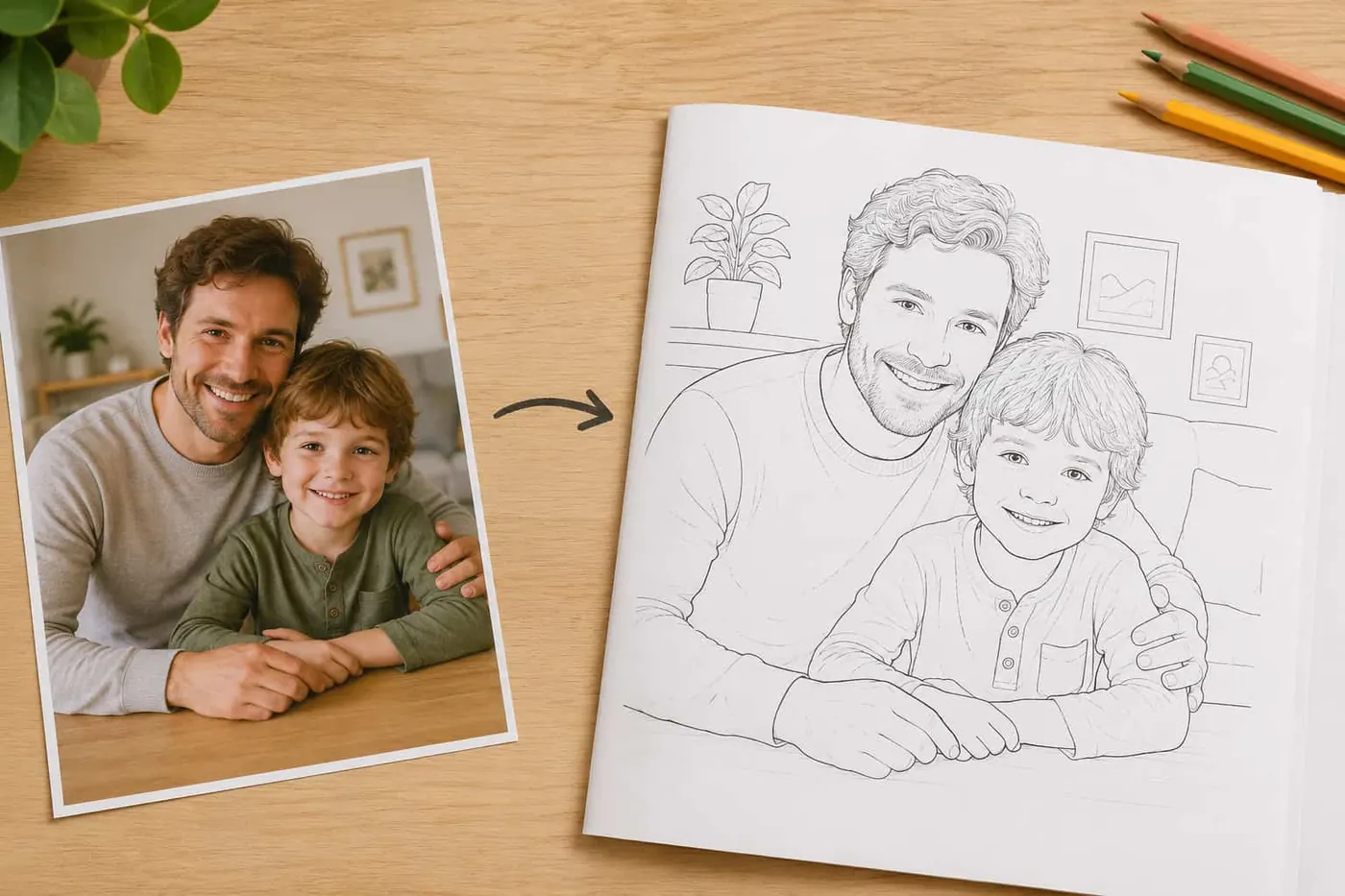
You can go one step further and start from their own world. Memory Pencil, for instance, makes personalized dot-to-dot pages from photos: a personal photo becomes a model page and a page of numbered dots to connect, before coloring the finished drawing.
Create a dot-to-dot book from your own photos
Each photo becomes a model page and a page of numbered dots to connect.
Discover personalized dot-to-dot5. The physical quality of the book
For a printed book, also look at the format, the paper and how easily the pages stay flat and usable while drawing.
A book that is too small can make the dots hard to tell apart. A comfortable surface, on the other hand, leaves more room for the stroke.
The pencil matters too: to start out, one that is easy to grip and glides properly on the paper is largely enough.
Classic or personalized dot-to-dot: which to choose?
A classic book works very well for multiplying activities, while personalized dot-to-dot adds an emotional dimension to the drawing.
The mechanics stay similar, but the final discovery changes.
| Classic book | Personalized dot-to-dot |
|---|---|
| Drawings prepared in advance | Drawings made from personal photos |
| Generic themes | Family, holidays, pets, birthdays… |
| The child discovers an unknown picture | The child can recognize a memory |
| Suited to everyday use | Especially fitting as a keepsake or a gift |
| Same content for everyone | Content unique to the person or family |
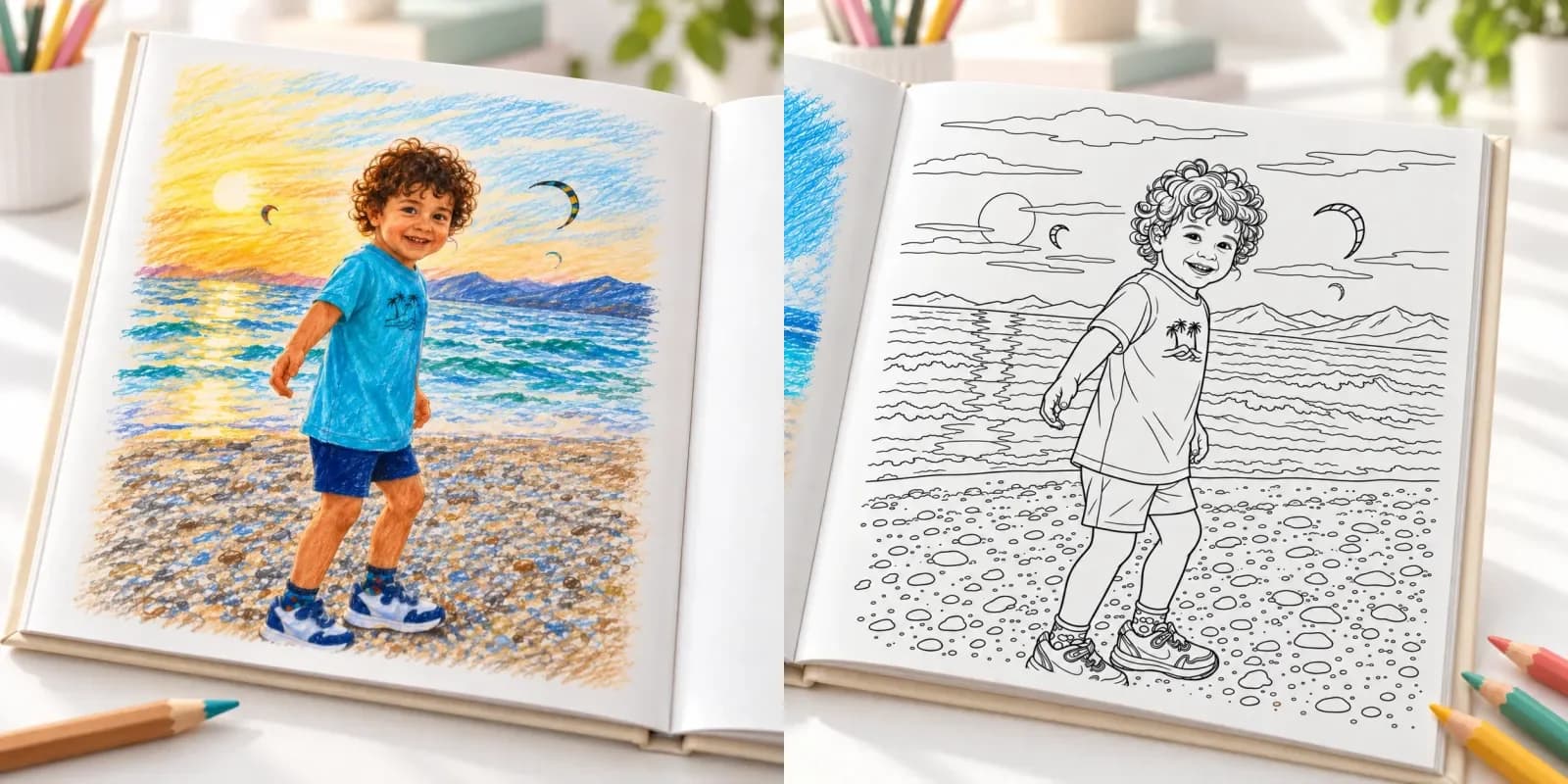
Memory Pencil, for example, turns photos into several kinds of activities: free coloring, color by number and dot-to-dot. For dot-to-dot, the photo's silhouette is revealed by following the numbers, then can be colored in.
The appeal is most obvious with a familiar photo: a pet, grandparents, a day at the beach or a birthday become the very subject of the activity.
To vary the exercises within a single book, Memory Pencil also offers a book that mixes outline coloring, color by number and dot-to-dot.
How do you know the book is too hard?
A book is probably too hard when the child can no longer follow the logic of the activity without near-constant help.
A few warning signs:
- they search for each number for a very long time;
- they regularly skip several dots without noticing;
- the digits are hard to recognize;
- they keep losing track of the sequence;
- the dots are too close for their level of precision;
- they ask to stop before the end of almost every drawing.
An occasional mistake is perfectly normal. The goal is not perfectly straight lines.
But if every page turns into a string of corrections, it is better to step back temporarily to a more accessible level.
And if the book is too easy?
The opposite problem exists too. Always connecting ten widely spaced dots can quickly lose its appeal for a child who already masters much longer number sequences.
You can then gradually raise the difficulty with:
- more dots;
- higher numbers;
- dots that are closer together;
- drawings with more changes of direction;
- scenes whose silhouette is harder to guess;
- several elements to complete on the same page.
The goal is not to chase the biggest possible number, but a level that is slightly stimulating without becoming laborious.
How can you make dot-to-dot more fun?
Once the drawing is finished, nothing says the book has to be closed right away.
The revealed shape can become the starting point of a second activity.
Color the drawing
It is the most natural follow-up. The child connects the dots, then colors the shape they revealed.
They can stick to the model's colors or, on the contrary, invent a whole new world.
Guess the drawing before the end
After 5, 10 or 20 dots, simply ask: "What do you think is going to appear?"
The drawing then also becomes a little observation game.
Make up a story
Once the picture is revealed, use it as a starting point:
- "Where is this dinosaur going?"
- "What's this dog's name?"
- "Who lives in this house?"
The book is then no longer just a drawing exercise: the picture feeds imagination and conversation.
Use personal memories
With personalized dot-to-dot, the game can also become a memory game: trying to recognize the photo or the memory before all the dots are connected.
It works especially well with a family book made of holidays, celebrations, portraits or everyday moments.
Create an activity book from your own memories
Your photos become dot-to-dot pages to discover, then to color.
Turn my photos into dot-to-dot pagesWhich mistakes should you avoid when choosing?
The first mistake is choosing solely by the age printed on the cover. The child's real level is more relevant.
Also avoid:
- starting with hundreds of dots because the final drawing looks spectacular;
- choosing digits that are too small;
- buying based on page count alone;
- imposing a theme the child does not care about;
- correcting every little wobble in the line;
- systematically turning the activity into schoolwork;
- sticking with a far-too-easy book for months.
Finally, do not confuse difficulty with quality. A complex book is not necessarily a better one. The best book is the one that makes the child want to find the next dot.
Dot-to-dot, coloring or color by number: how to choose?
These three activities all rely on drawing, but they do not offer exactly the same experience.
| Activity | Principle | Especially suited to |
|---|---|---|
| Dot-to-dot | Follow a sequence to reveal the drawing | Children who love searching and discovering |
| Free coloring | Fill in a drawing freely | Creativity and color choices |
| Color by number | Color zones following a key | Children who enjoy guided activities |
| Mixed book | Alternate several activities | Variety within a single book |
There is no need to settle on one for good. Alternating formats is exactly what keeps the activity fresh.
Memory Pencil applies these three approaches to personal photos: the personalized coloring book leaves more freedom, while dot-to-dot adds the discovery step.
Conclusion: which dot-to-dot book should you choose?
To choose a dot-to-dot book well, start from the child's real level: which numbers do they recognize? Can they follow a sequence alone? Are they comfortable with a pencil? Do they want to finish the drawing?
Then favor readable digits, a gradual difficulty curve, suitable spacing and, above all, a world they love. A successful book is neither the one with the most dots nor the one promising the most complex drawings: it is the one the child wants to open again.
And to step away from classic themes, dot-to-dot pages can also start from photos and personal memories, turning the final drawing into a familiar picture to discover and then color.
Dot-to-dot books FAQ
From what age can children do dot-to-dot?
There is no single age. The activity becomes relevant once the child can identify the symbols used, understand the requested order and guide their pencil well enough. For the youngest, start with very few dots and simple lines.
How many dots for a preschooler?
It is better to rely on the numbers the child actually recognizes rather than on a standard figure tied to their age. France's national curriculum indicates that by the end of preschool children are familiar with small numbers and can count out loud to at least 30, but skills build gradually.
Do dot-to-dot pages help with learning numbers?
They let children handle a number sequence within a concrete activity, but they do not replace learning suited to the child. The principle notably requires identifying the next number and placing it back in a sequence.
Do dot-to-dot pages build fine motor skills?
The activity works pencil control and visual-motor coordination. Pediatric therapy services within the NHS include dot-to-dot among the activities suggested to work on these dimensions.
What if my child often picks the wrong number?
First check that the digits are big enough and that the sequence matches what they know. You can occasionally help them find the next number without drawing in their place. If mistakes become systematic, switch temporarily to shorter exercises.
Are dot-to-dot pages better with or without numbers?
Numbered dots are interesting once the child starts recognizing and ordering numbers. For a child who does not know digits yet, activities based on shapes, colors or very simple lines can be more accessible.
Can you create dot-to-dot pages from a photo?
Yes. Memory Pencil notably turns personal photos into personalized dot-to-dot pages: the picture becomes the basis of the drawing, whose silhouette appears by following the numbered dots before coloring.
Which theme should you pick for a dot-to-dot book?
Start with a world the child loves: animals, vehicles, space, dinosaurs or characters, for example. Another option is to use pictures that are directly familiar to them, such as photos of family, holidays or their pet.
Our personalized books made from your photos
Three ways to turn your family photos into an activity book, from free coloring to guided play.
- Personalized coloring bookEach photo becomes a color keepsake page and the same scene to color freely.
- Personalized color by numberYour photos as numbered zones with a color legend: guided coloring, true to the memory.
- Personalized dot to dotThe drawing of your photo appears as you connect the numbers, then gets colored in.
Ready to turn your photos into a coloring book?
Designed in France, checked page by page before printing.
See the formats and create my bookRead next
Practical guide
Everfold, My Colorful World, Us in Colors and Memory Pencil: one page per photo, or two?
Everfold, My Colorful World and Us in Colors turn each photo into one black-and-white line-art page. Memory Pencil, which wrote this comparison, makes two: a color reference page of the memory, then the same scene to color.

Practical guide
Personalized coloring book: turning your family memories into a creative activity
A beautiful personalized coloring book takes more than gathering your favorite photos. Sharp faces, readable scenes, a coherent story: the full guide to choosing and organising your photos.

Practical guide
Personalized coloring book prices in 2026
Compare printed and PDF coloring book prices, cost per photo, included services, and the details to check before ordering.